MANAGING HYPERMOBILITY
Building Strength & Stability
Understanding how strength, control and gradual loading can help support hypermobile bodies and build confidence in movement.
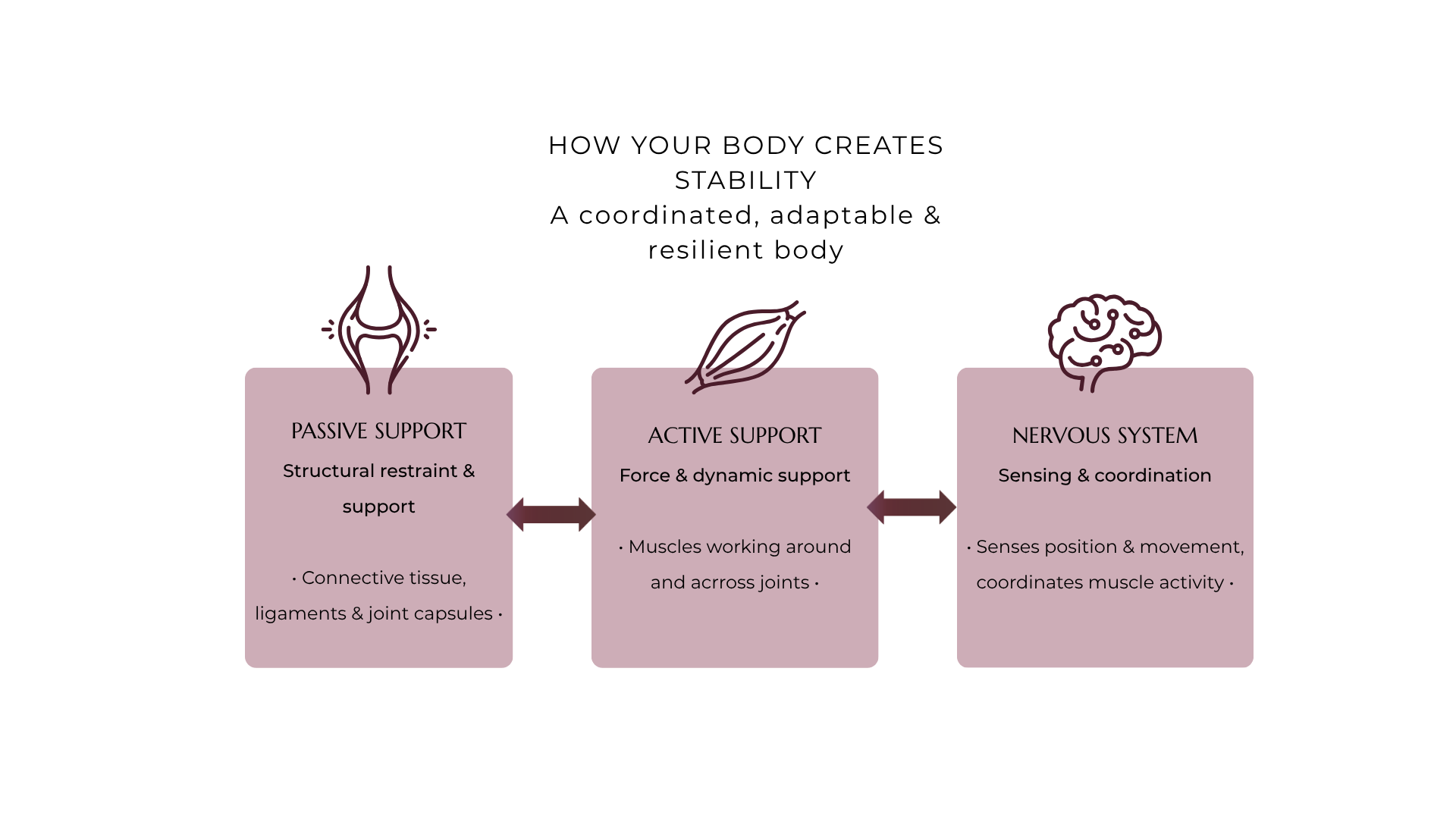
HOW YOUR BODY CREATES STABILITY
Stability is something your whole body creates.
Your body doesn't rely on one structure to keep you stable. Stability comes from different systems working together to support and control movement.
Passive support comes from structures such as ligaments, joint capsules and other connective tissues, which help provide restraint without needing to actively contract.
Active support comes from muscles producing force around and across joints.
Your nervous system helps coordinate this — using sensory information about position and movement to organise when, where and how much muscular activity is needed.
These systems aren't working separately. They work together to create the support and control your body needs as you move through the world.
These systems work together, the contribution of each can vary between people, joints, positions and activities.
WHEN PASSIVE SUPPORT IS DIFFERENT
This balance can look different in a hypermobile body.
For people with symptomatic hypermobility, connective tissues may provide less passive restraint and support. This contributes to greater movement and can mean that the other parts of the stability system have more work to do.
But muscular strength is one element that we can influence.
By building strength, coordination and control, we can give the body more active support and more capacity to manage movement and load.
But there is an important limit to what strengthening can do.
we can't make better connective tissue…
We can build more support around our body, but strengthening can't replace the connective tissue we started with.
Being strong doesn't mean you'll never experience instability, pain or injury — and needing other forms of support doesn't negate the strength you've built.
BUILDING CONTROL
More movement isn’t always the answer. Sometimes it’s more control.
Hypermobile bodies often have access to plenty of movement… duh we know this, we’re hyper-mobile!
Strength and stability work can help us develop the ability to produce force and maintain control through the ranges that matter to us.
That might initially mean working in a smaller or more supported range, then gradually exploring different positions, loads and ranges as control develops.
It doesn't mean end-range movement is inherently dangerous, or that every joint needs to stay perfectly “neutral”.
Some ways of moving can be particularly useful when we're building strength, stability and control.
-
![Photo by <a href="https://unsplash.com/@annes02?utm_source=unsplash&utm_medium=referral&utm_content=creditCopyText">Anes Hamzic</a> on <a href="https://unsplash.com/photos/a-woman-in-a-black-top-is-doing-a-push-up-os93oC-lXQ0?utm_source=unsplash&utm_]()
1- Isometric Loading
Creating force without lots of movement.
Isometric exercise involves producing muscular force while keeping the joint relatively still. This can be useful when movement through range is uncomfortable or provocative, or when you're beginning to build muscular support and control around an area.
For some people, isometrics can also provide temporary symptom relief — and they're easy to sneak into everyday life without needing a whole workout.
IN PRACTICE: Holding a position, pushing into a wall, or resisting against your hand, a band or another surface.
I regularly remember my wrist isometrics while sitting at traffic lights…
-
![Photo by <a href="https://unsplash.com/@sunday2sunday?utm_source=unsplash&utm_medium=referral&utm_content=creditCopyText">SUNDAY II SUNDAY</a> on <a href="https://unsplash.com/photos/a-woman-squatting-on-the-floor-in-a-gym-snM3yEpvklU?utm_source=unsp]()
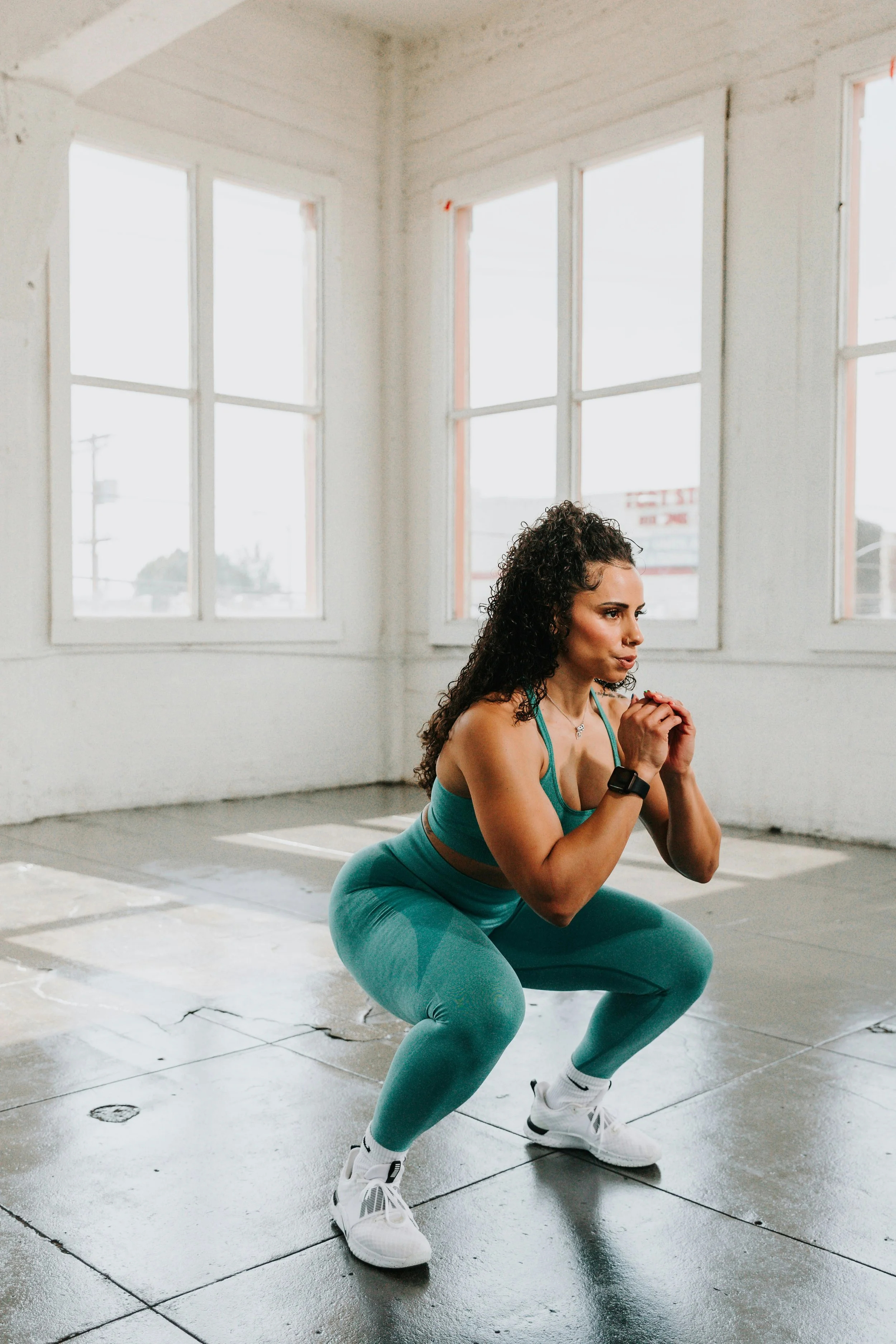
2- Closed Chain Movements
Using contact and support to build control.
Closed-chain exercises keep your hand or foot in contact with a relatively fixed surface. That contact can provide additional feedback while encouraging muscles to work together to support and control movement.
For some hypermobile bodies, this can be a useful way to develop strength, body awareness and control before progressing into movements that require more independent control through space.
IN PRACTICE: Squats, bridges, wall push-ups, step-ups or weight-bearing through your hands.
Open-chain exercise matters too — it's another way to build strength and control through movement.
-
![Photo by <a href="https://unsplash.com/@galibagi?utm_source=unsplash&utm_medium=referral&utm_content=creditCopyText">GALINA BOGDANOVA</a> on <a href="https://unsplash.com/photos/woman-performing-a-barbell-lunge-exercise-in-a-gym-DVstISE8p8w?utm_sourc]()
3- Slow & Controlled Loading
Giving your body time to produce and control force.
Slowing a movement down can reduce reliance on momentum, give you more time to notice what your body is doing, and increase the time your muscles spend producing and controlling force.
This can be particularly useful when learning a movement or building control through a range.
IN PRACTICE: Slow the lowering phase, add a pause or hold, or deliberately control both directions of a movement.
Slow isn't always the end goal. Speed and power can also be gradually trained when they're relevant to your life or sport.
-
![Photo by <a href="https://unsplash.com/@jballantyne?utm_source=unsplash&utm_medium=referral&utm_content=creditCopyText">Jesse Ballantyne</a> on <a href="https://unsplash.com/photos/woman-doing-yoga-W5zTPoCVai0?utm_source=unsplash&utm_medium=referral&]()
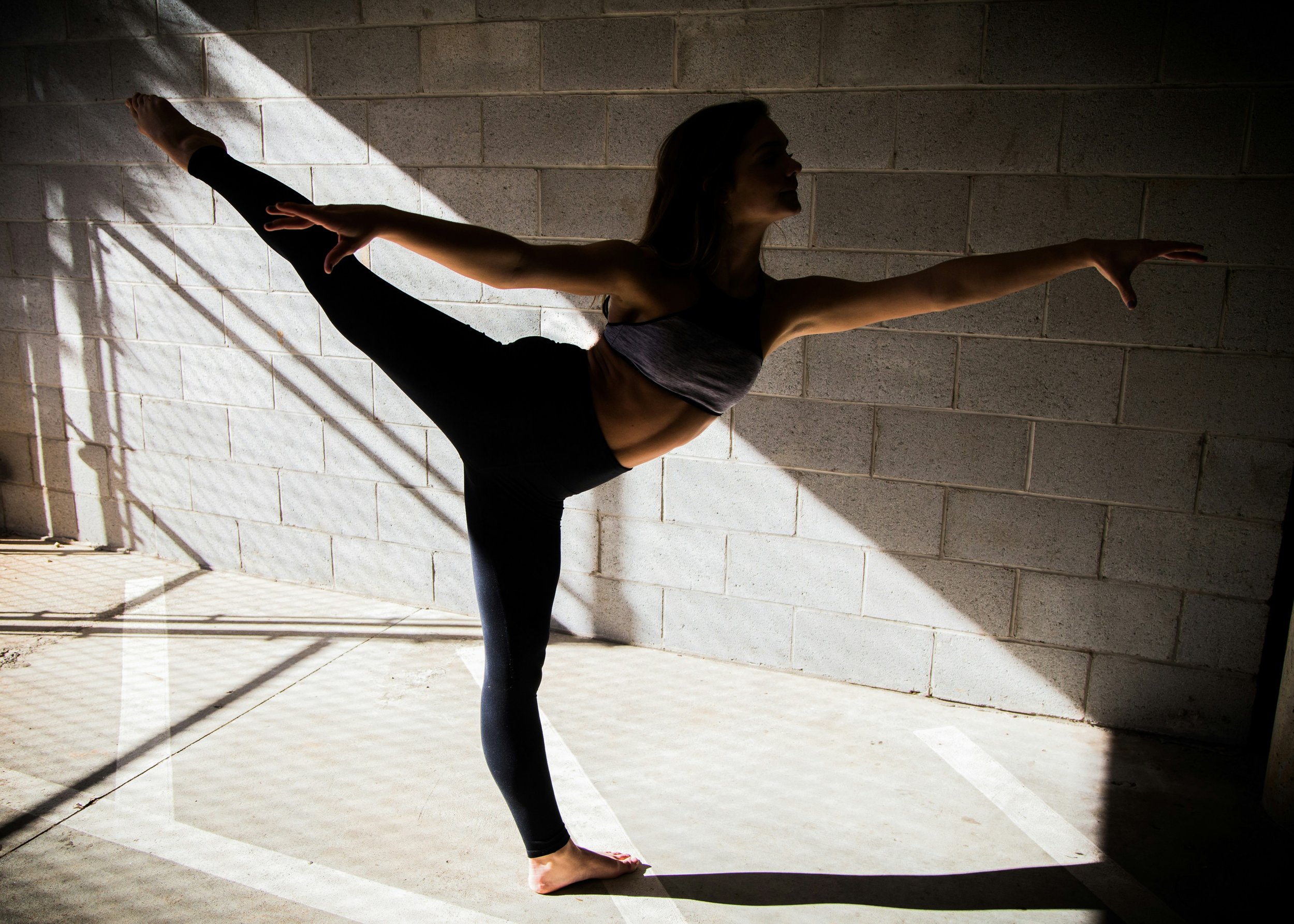
4- Proprioception & Body Awareness
Learning where your body is without always having to look.
Proprioception is your ability to sense where your body is positioned and how it's moving. This can be altered in hypermobility, making body awareness and movement control useful things to practise alongside strength.
And it doesn't have to mean balancing on increasingly ridiculous unstable surfaces.
IN PRACTICE: Using a mirror, touch or external cue for feedback; practising balance; moving slowly enough to notice position; or learning to recognise where a joint is within its range.
-
![Photo by <a href="https://unsplash.com/@joelvalve?utm_source=unsplash&utm_medium=referral&utm_content=creditCopyText">JoelValve</a> on <a href="https://unsplash.com/photos/woman-doing-split-while-standing-on-one-leg-eWAK-rslNn0?utm_source=unsplash&ut]()
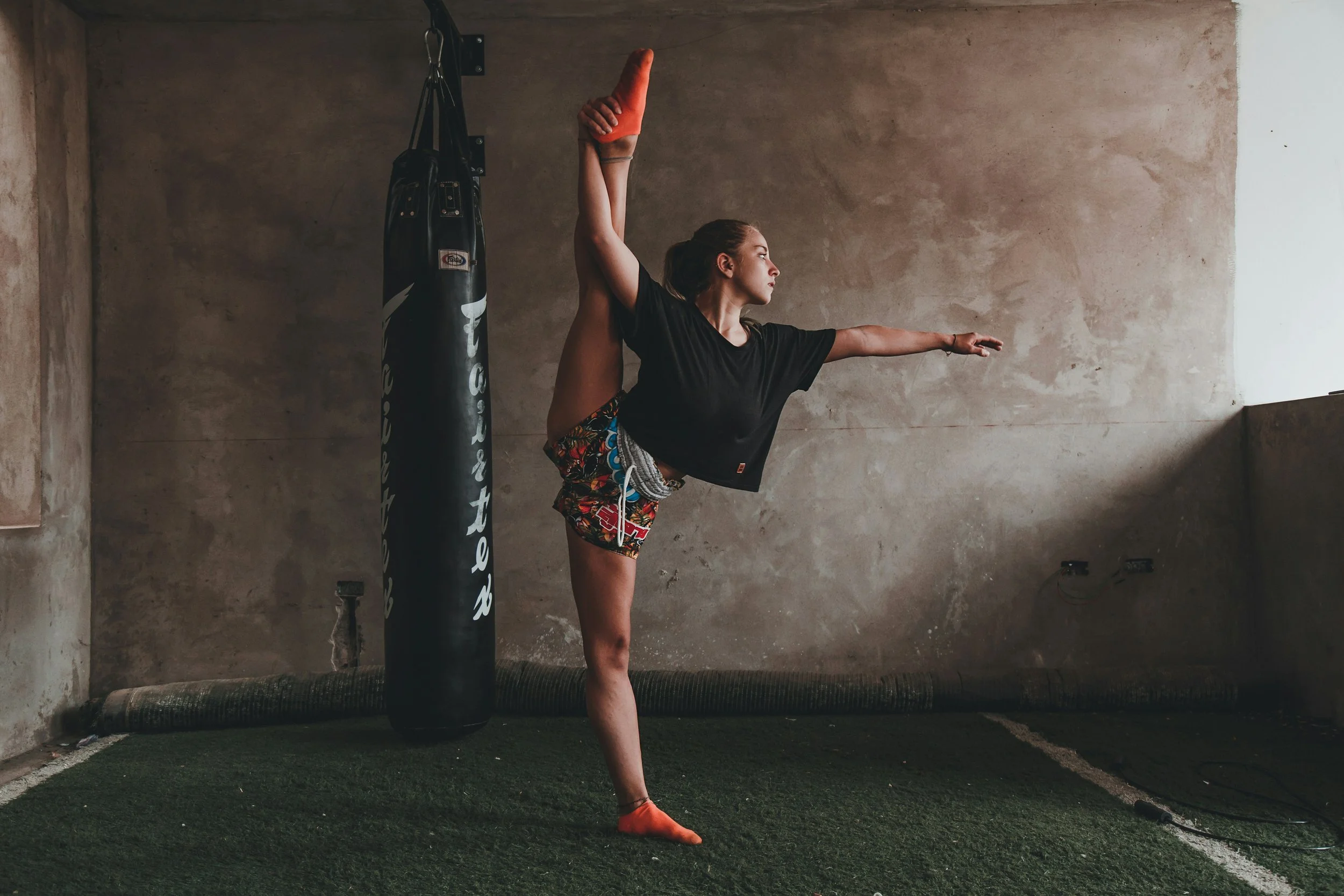
5- Strength Through Useful Range
Building control through movement rather than simply avoiding it.
Having a large range of movement doesn't automatically make that range dangerous. Rather than trying to keep every joint permanently in a small “neutral” range, we can gradually build strength and control through the ranges that are useful to us.
Where you begin will depend on your body. You might initially work within a smaller or more supported range and explore further as control develops — or full-range movement may already be appropriate for you.
IN PRACTICE: Choose a range you can currently control, then gradually explore and strengthen more of your available movement where useful.


STRETCHING A HYPERMOBILE BODY
Feeling tight doesn't always mean you need to stretch.
Sometimes that tightness is coming from muscles that are working hard, are fatigued, or are trying to contribute to stability.
And this can create a frustrating cycle:
You feel tight → you stretch → it feels better temporarily → you feel tight again → so you stretch even further.
When you have a large amount of available joint movement, you may need to move through a considerable amount of range before you actually feel the muscle you're trying to stretch.
Sometimes the movement ends up coming predominantly from the already-mobile joint rather than effectively targeting the muscle.
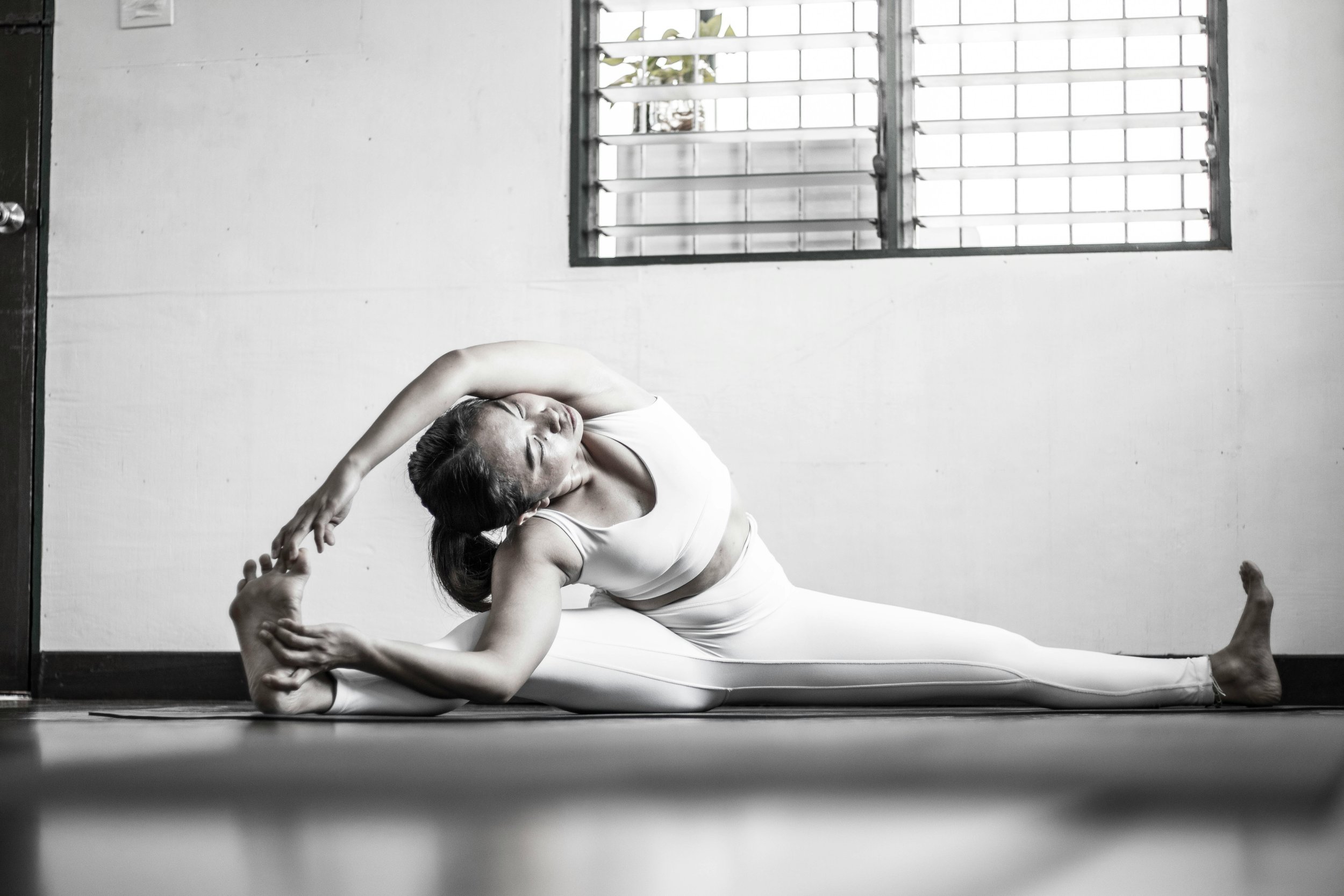
Passive Stretching
An external force, like gravity, your hand or a strap, moves you further into a position.
This can be useful for targeted stretching, but more range isn't always what a hypermobile body needs.

Active Mobility
Your muscles create and control the movement.
This helps develop strength and control within the range you can access, rather than relying only on passive flexibility.
For a body that already has plenty of passive range, developing active control can sometimes be more useful than continually chasing greater flexibility.
PROGRESSING STRENGTH
Progress doesn't always mean adding more weight.
Our bodies adapt when they're given an appropriate challenge and enough opportunity to recover.
Progress might involve more resistance, more repetitions, a different range, less support, greater complexity or eventually more speed.
But harder isn't automatically better.
Better control at the same load is progress. Recovering more easily is progress. Returning after a flare is progress. Maintaining your capacity during a difficult period is progress too.
We'll explore this more in Managing Load, Energy & Recovery.
FINDING MOVEMENT THAT WORKS FOR YOU
The “best” exercise has to work for the person actually doing it.
Movement might look like lifting weights, Pilates, swimming, cycling, climbing, dancing, yoga, pole, resistance bands, gardening, sport or exercising at home.
But if you hate the movement you're doing and have to continually force yourself through it, it's probably not going to be particularly sustainable. Enjoyment matters. And your brain gets a say too.
You might need routine or novelty. Music or silence. Company or solitude. A detailed program or as little setup as humanly possible.
All of this is useful information about how to make movement workable for you.
Your starting point matters too. One hypermobile person might currently be rebuilding tolerance with small amounts of supported movement, while another might be lifting heavy weights, climbing or competing in sport.
Hypermobility doesn't automatically mean beginner exercise. Start with the body and capacity you actually have.
WHEN MOVEMENT HURTS
Pain is information, not a test you have to pass.
If a movement hurts, that's information.
It might mean changing the load, range, position, speed or amount you're doing. It might mean you need more support or recovery. Or that particular exercise may simply not be the right option right now.
Modify it. Adapt it. Reduce it. Or find another way to work towards the same goal.
If something repeatedly causes significant pain, instability, new symptoms or worsening function, stop and reassess rather than continuing to push through it.
BUILDING STRENGTH FOR YOUR LIFE
The goal isn't to become good at rehabilitation.
Strength is useful because of what it allows you to do.
Getting off the floor. Carrying your shopping. Working. Walking further. Gardening. Picking up your child. Dancing. Going to the gym. Returning to sport. Having more energy left for the rest of your life.
Different lives require different kinds of strength.
You don't need to build somebody else's version of a strong body. You are building support and capacity for your body & your life.