UNDERSTANDING HYPERMOBILITY
Understanding Symptomatic Hypermobility
Let’s look at what can happen when being hypermobile starts affecting how your body feels and functions.
CONNECTIVE TISSUE & HYPERMOBILITY
The thread that connects it all
We’ve heard that connective tissue is found throughout the body. But not all connective tissue is the same, and how it behaves depends on what it is made from and how those components are organised.
Connective tissue contains different proteins and other components, including collagen, which work together to give tissues their particular mechanical properties. Our genes provide instructions involved in making, organising and maintaining many of these components.
In some heritable connective tissue disorders, including other types of Ehlers-Danlos syndrome (EDS), changes in particular genes are known to affect proteins involved in the structure or function of connective tissue.
In hEDS and HSD, the underlying genetic and molecular mechanisms have not yet been fully established. But we can still observe that connective tissues can behave differently — and this can influence how the body responds to movement and load.
WHEN CONNECTIVE TISSUE BEHAVES DIFFERENTLY
What does this mean for stability?
Because connective tissue helps provide support and stability throughout the body, differences in how these tissues behave can change the way a hypermobile body creates, experiences and maintains stability.
I often explain this to my patients by saying that our connective tissue doesn't always “hold us together” in quite the same way.
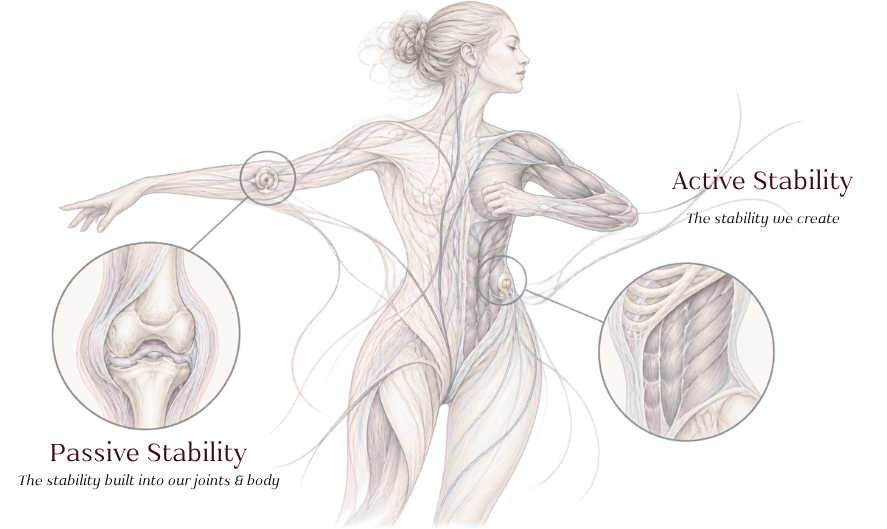
Around our joints, connective tissue structures provide passive stability- support that doesn't require us to consciously activate our muscles.
In hypermobile people, these tissues can allow more movement before reaching their limit. This is part of why our joints can move further, and can also contribute to the joint laxity and instability that some hypermobile people experience.
But having more movement available doesn't necessarily mean a joint is unstable. Our bodies have other ways of creating and controlling stability too.
And this is where our muscles and nervous system come in.
WHEN THE BODY HAS TO WORK HARDER
How does a hypermobile body try to gain more stability?
Often, when passive stability isn’t as effective, our body finds ways to find more stability itself through seeking active stability- using our muscles to actively control and stabilise our joints, coordinated by the nervous system.
For some people, this can look like constantly tight muscles, bracing, gripping, locking joints at the end of their range, or developing particular movement patterns that make the body feel more secure.
And this can contribute to muscle fatigue, tension, pain or a feeling that the body is constantly working to hold itself together.
HELPING MAKE SENSE
Understanding the ‘why’ changes what we do next.
When your joints have less passive stability, your body often has to work harder to create stability elsewhere. Muscles may brace, movement patterns may change, and your nervous system may become increasingly protective.
This doesn’t mean the answer is simply to “strengthen everything” — or to stop moving.
The goal is to help your body develop more efficient, adaptable ways of creating stability, while working with your individual symptoms, capacity and needs.