MANAGING HYPERMOBILITY
Building Your Management Toolkit
Finding what works for your body, your brain and your life.
LET'S START WITH PERMISSION
You don't have to do everything.
Living with any chronic health condition often comes with an enormous list of things you're told you should be doing.
Exercises. Appointments. Pacing. Strengthening. Sleep routines. Braces. Compression. Supplements. Mobility aids. Pain strategies. Tracking symptoms. Managing stress. Changing how you move.
Even when those suggestions are well-intentioned, they can add up quickly, and be VERY draining.
Your health shouldn't become another place where you feel like you're failing.
Management isn't about doing everything you've ever been told might help. It's about understanding your options and working out what is actually useful, realistic and sustainable for you.
TOOLS, NOT RULES
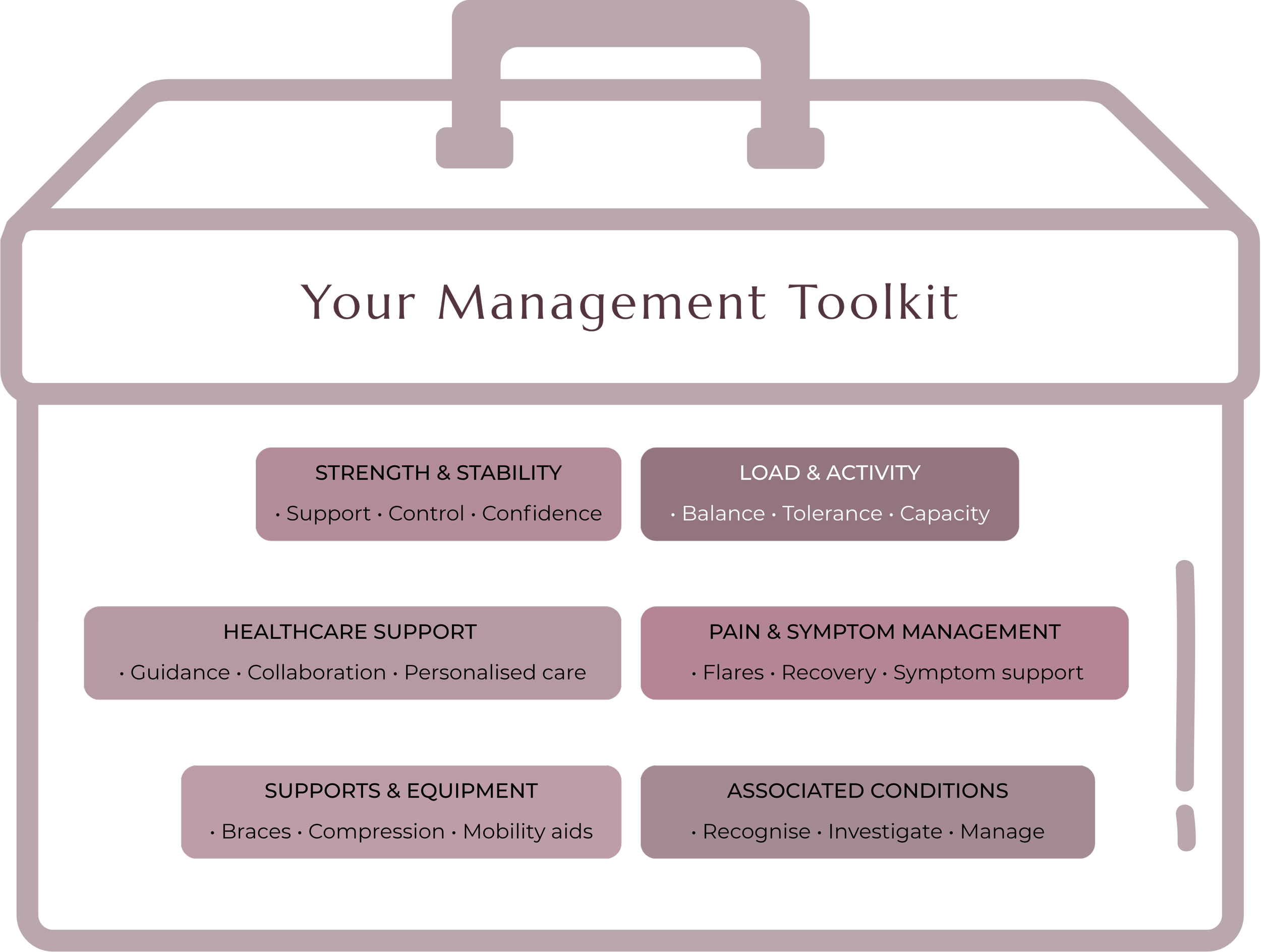
Think of management strategies as a toolkit, not a checklist.
A toolkit gives you options.
You might use some tools every day, some occasionally, some only during a flare, and some might never be useful for you at all.
Something can be evidence-informed, clinically reasonable or incredibly helpful for somebody else and still not be the right tool for you, at this time, or for your brain.
Knowing that an option exists doesn't create an obligation to use it.
WHAT WORKS HAS TO WORK FOR YOU
Your body matters, but so do all the other parts of you.
Something can be helpful for your symptoms and still be difficult to actually fit into your life.
A strategy might take more time, money, energy, planning, executive function or physical capacity than you currently have available.
When you're deciding whether something belongs in your toolkit, you might consider:
Your body: Does it actually help? How does your body respond?
Your brain: Is it cognitively realistic? Does it work with the way you remember, plan, focus and build routines?
Your energy: What does it cost you to do, and what else does that energy need to be used for?
Your capacity: Is this realistic for where you are right now?
Your wallet: Can you afford it without creating stress somewhere else in your life?
Your life: Does it actually fit around work, family, relationships, rest and the things that matter to you?
LETTING GO OF THE 'SHOULDS'
Missing an exercise doesn’t make you a criminal or mean you deserve to be in pain.
You might have exercises you haven't done. A brace you were told to buy but haven't. A routine that lasted three days. An appointment you've been meaning to make for six months.
None of those things say anything about how much you care about your health.
Sometimes you forget. Sometimes you're exhausted. Sometimes something costs too much. Sometimes your brain says absolutely not. Sometimes another part of your health takes priority. And sometimes a recommendation simply doesn't work for you. But this isn’t you failing, it’s you being human!
You can come back to something later. Adapt it. Ask for another option. Decide the benefit isn't worth the cost. Or choose not to do it at all.
YOUR TOOLKIT CAN CHANGE
What helps now might not be what you need forever.
Your symptoms, capacity, circumstances and priorities can all change over time. Your management can change with them.
Some strategies might become long-term parts of your life. Others might only be useful during a flare, while recovering from an injury, for particular activities, or during times when you need a little more support.
You might stop using something because you no longer need it. You might come back to something you haven't used for years. You might need more support than you used to, or find a completely different way of doing something.
None of that means you're going backwards or managing your health badly.
Using a brace, mobility aid, compression garment or other support doesn't mean your body has “failed”. And building strength or capacity doesn't mean that success is eventually needing no support at all.
The goal is to have options you can pull from when you need them, and permission to change those options as your needs change.
BUILDING YOUR TOOLKIT
Start where you are.
As you move through the rest of this pathway, you'll come across different strategies, supports and ideas.
They're options, not instructions.
Take what feels useful. Leave what doesn't. Come back to things later. Talk them through with the people supporting you. Adapt them to fit your circumstances.
You don't have to overhaul your life.
You might simply ask:
What is making life hardest right now?
What might make that a little easier?
What do I realistically have capacity for?