UNDERSTANDING HYPERMOBILITY
Making Sense of your Hypermobility
Not sure what being hypermobile means? Let’s explore it together.
You’ve landed here. Let’s start with what you know.
You might have landed here after a long journey, or this might be the very beginning. Either way, welcome.
• Maybe a practitioner has mentioned that you’re hypermobile, but you’re not really sure what that means.
• Maybe you saw something about hypermobility online and a little light bulb went off — wait... could this explain some things?
• Or maybe you’ve spent years managing symptoms that have always been treated as separate things, and you’re starting to wonder whether there might be something connecting them.
Wherever you’re starting from, I don’t expect you to understand all of this yet.
There can be a lot to take in, and you absolutely do not need to figure it all out at once. Start slowly. Learn a little, reflect on what feels relevant to your experience and your body, and come back to things when you need to.
STARTING WITH THE BASICS
What does being hypermobile actually mean?
Hypermobility describes joints that move beyond the range we would typically expect. This definition tells us what happens at our joints, but it doesn't tell us the whole story.
Our joints are held together and guided by structures such as ligaments, tendons, joint capsules and fascia, which are made largely from connective tissue.
When connective tissue has different mechanical properties, our joints may move further than is typical. That's what we call hypermobility.
For many people, that's simply a normal variation of the human body.
But for others, being hypermobile comes with symptoms and difficulties that can have a significant impact on their body and their life. In these people, hypermobility may be one part of a much bigger picture.
What matters is the context it appears in.
SEEING THE BIGGER PICTURE
Could my symptoms be connected?
Connective tissue is found throughout your entire body, where it helps to support, connect and provide structure to your muscles, nerves, blood vessels, organs and more.
Because connective tissue is an integral part of so many systems in the body, it makes sense that differences in connective tissue can have effects that extend well beyond our joints. For some people, this can involve the digestive system, nervous system, cardiovascular system, skin and more.
This is why symptoms that initially seem completely unrelated can sometimes be part of a bigger picture, and why recognising that bigger picture is so important.

UNDERSTANDING THE LABELS
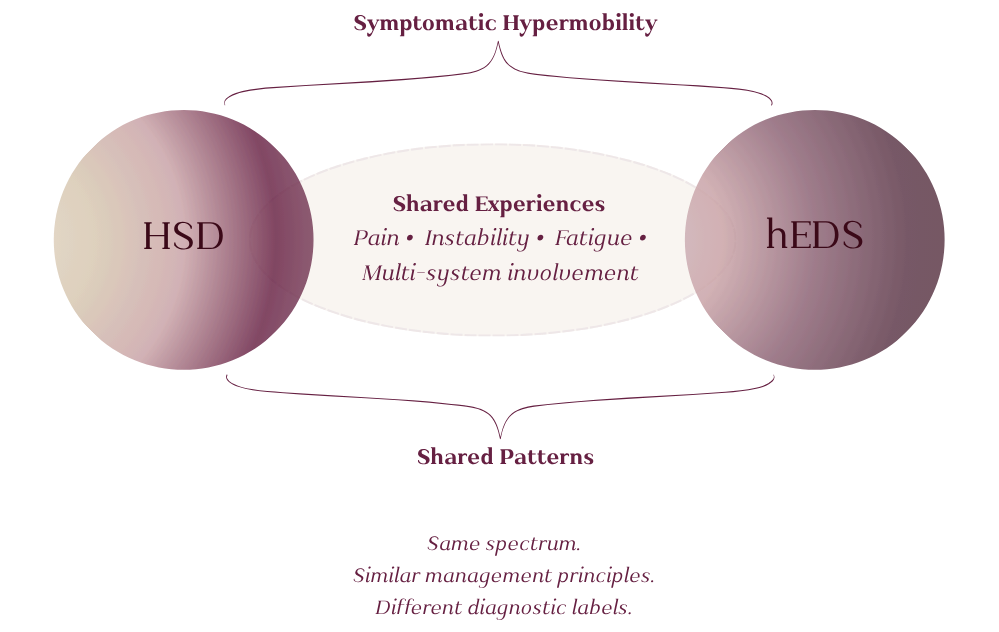
Where do HSD and hEDS fit into all of this?
If you've started reading about hypermobility, you've probably come across the terms HSD (Hypermobility Spectrum Disorder) and hEDS (hypermobile Ehlers-Danlos syndrome).
Both are diagnoses associated with symptomatic hypermobility, where hypermobility occurs alongside pain and other symptoms that affect how your body functions.
hEDS is diagnosed when someone meets a specific set of clinical criteria.
HSD describes symptomatic joint hypermobility when another condition does not better explain the presentation. Some people with HSD may share features with hEDS without meeting the current hEDS diagnostic criteria.
It's important to know that a diagnosis of HSD doesn't mean your symptoms are less significant than someone with hEDS. The diagnostic label and the impact a condition has on someone's life are not the same thing.
LOOKING WHERE YOU MAY FIT
How do I work out what I have?
Unfortunately, there isn't one simple test that can tell us whether you have HSD or hEDS. It's more about putting the pieces of your individual puzzle together.
We look at how your joints move now, whether you were more flexible when you were younger, your symptoms and injury history, other signs that your connective tissue might be involved, your family history, and whether there could be something else going on that we need to consider.
For hEDS, there is also a specific set of diagnostic criteria that we need to work through.
And importantly, assessing hypermobility is about much more than bending your elbows and knees and calculating a Beighton score.
Want to understand the assessment process? →
Explore assessment, the Beighton score, diagnostic criteria and who may be involved.